
جودة الهواء الداخلي وأثرها على إنتاجية العمل: رؤى مستندة إلى البيانات
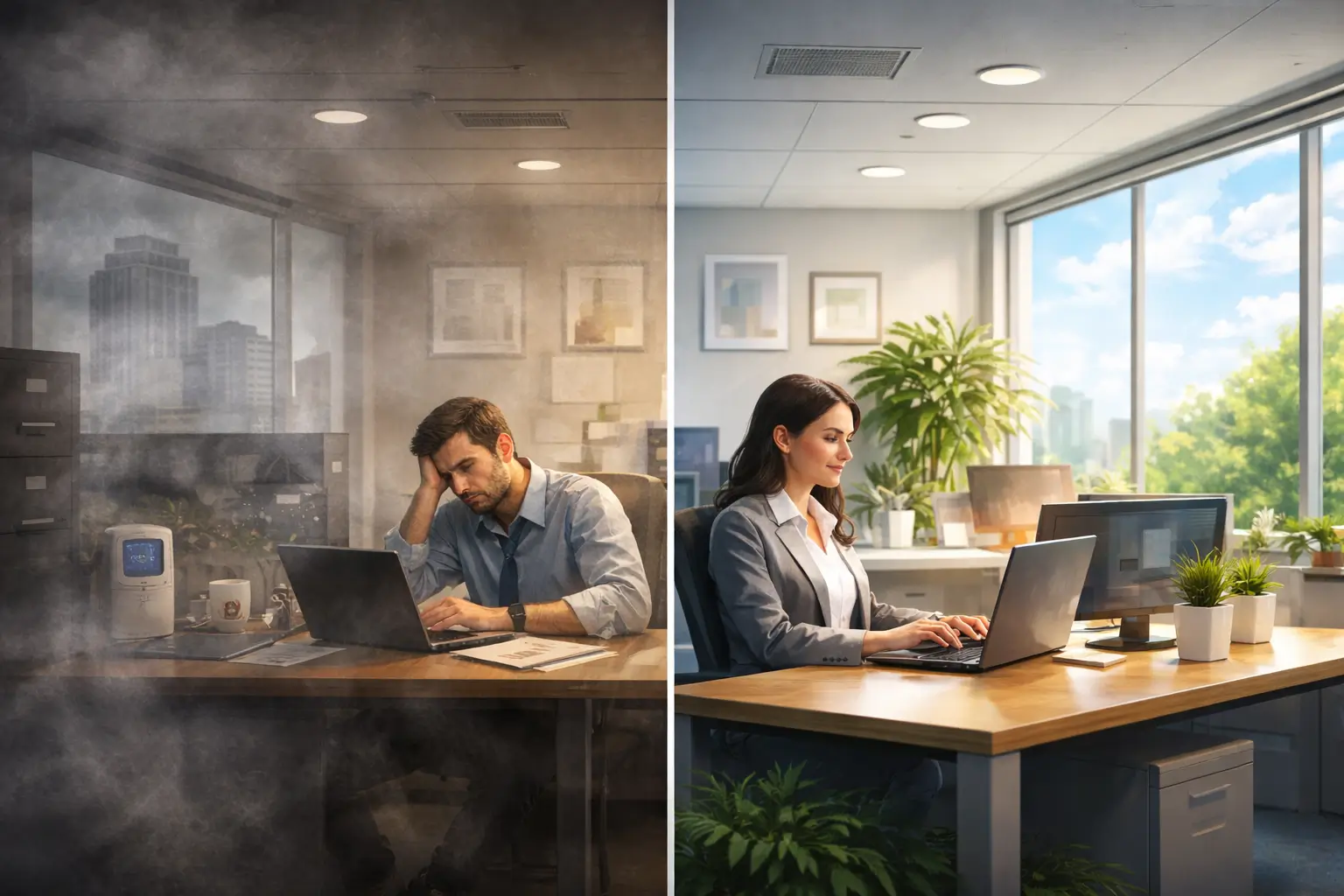
In 2015, researchers at Harvard T.H. Chan School of Public Health conducted a study that would fundamentally change how building professionals think about indoor air. The COGfx Study placed workers in controlled office environments and systematically varied ventilation rates and pollutant levels while measuring cognitive performance. The results were striking: employees working in well-ventilated, low-pollutant environments scored 101% higher on cognitive function tests than those in conventional office conditions. Decision-making performance improved by 131%, and crisis response scores increased by 288%.
These weren’t marginal improvements. They represented a doubling of cognitive capacity simply by improving the air people breathe. For building owners and facility managers responsible for commercial real estate, this research marked the beginning of an evidence-based conversation about what indoor air quality actually costs—and what addressing it can return.
The Data: What Peer-Reviewed Research Tells Us
The Harvard COGfx findings didn’t emerge in isolation. A substantial body of peer-reviewed research now connects specific indoor air pollutants to measurable declines in human performance.
Carbon Dioxide and Cognitive Function
A 2012 study published in Environmental Health Perspectives by Satish et al. at Lawrence Berkeley National Laboratory examined cognitive performance at CO2 concentrations of 600, 1,000, and 2,500 ppm. At 1,000 ppm—a level commonly found in occupied conference rooms—test subjects showed statistically significant declines in decision-making performance. At 2,500 ppm, performance on seven of nine cognitive tests dropped to levels the researchers categorized as “dysfunctional.”
A 2016 follow-up study by Allen et al., published in Environmental Health Perspectives, found that for every 100 ppm increase in CO2 above outdoor baseline levels, cognitive scores decreased by approximately 2.4%. This dose-response relationship suggests there is no “safe” threshold—the lower the CO2, the better the cognitive performance.
Volatile Organic Compounds and Health Outcomes
Research published in the International Journal of Environmental Research and Public Health in 2017 examined VOC exposure in office environments. Buildings with total VOC levels exceeding 500 μg/m³ showed 23% higher rates of reported headaches, fatigue, and difficulty concentrating among occupants. The study also documented a direct correlation between elevated VOC concentrations and short-term sick leave.
Particulate Matter and Absenteeism
A 2020 study in Environmental Science & Technology tracked office worker productivity and health outcomes relative to PM2.5 exposure. Researchers found that a 10 μg/m³ increase in indoor PM2.5 was associated with a 1.35% decrease in work output and a 6% increase in absenteeism over a 12-month period. The study estimated that U.S. businesses lose approximately $150 billion annually to productivity losses attributable to poor indoor air quality.
Combined Effects
Perhaps most importantly, the research demonstrates cumulative effects. The Harvard COGfx Study found that improvements in ventilation combined with reductions in VOCs produced cognitive gains greater than either intervention alone. Buildings with multiple IAQ deficiencies don’t just have additive problems—they have compounding ones.
What “Poor IAQ” Actually Means: Defining the Thresholds
Understanding what constitutes acceptable indoor air quality requires reference to established standards. Two frameworks dominate professional practice.
ASHRAE Standard 62.1
ASHRAE Standard 62.1, “Ventilation for Acceptable Indoor Air Quality,” establishes minimum ventilation rates for commercial buildings. The standard specifies outdoor air requirements based on occupancy density and space type. For typical office environments, this translates to approximately 17 CFM per person at standard occupancy densities. The standard implicitly targets CO2 levels below 1,000 ppm above outdoor ambient concentrations.
Key ASHRAE 62.1 thresholds include:
- CO2: 700 ppm above outdoor levels (typically resulting in indoor concentrations of 1,100-1,200 ppm)
- Minimum outdoor air rates: 5-20 CFM per person depending on space type
- Required air quality monitoring in high-density spaces
WELL Building Standard
The WELL Building Standard, developed by the International WELL Building Institute, establishes more stringent performance targets:
- CO2: Below 800 ppm (WELL Air Feature A01)
- PM2.5: Below 15 μg/m³ (WELL Air Feature A01)
- Total VOCs: Below 500 μg/m³ (WELL Air Feature A03)
- Formaldehyde: Below 27 ppb (WELL Air Feature A03)
The gap between ASHRAE minimums and WELL targets represents the difference between “acceptable” and “optimal.” Buildings meeting only ASHRAE minimums may still experience measurable productivity impacts based on the research data.
Measurable Business Impact: Quantifying the Costs
The financial implications of indoor air quality extend across multiple cost categories.
Absenteeism
According to the U.S. Bureau of Labor Statistics, the average American worker misses 7.8 days per year due to illness or injury. Research from the EPA and Lawrence Berkeley National Laboratory suggests that improved indoor air quality can reduce sick building syndrome symptoms by 20-50%, translating to 1.5 to 4 avoided sick days per employee annually. At a median salary of $56,000, this represents $300 to $800 per employee in direct wage savings.
Productivity Losses
The World Green Building Council’s 2014 report “Health, Wellbeing & Productivity in Offices” synthesized research showing that improved indoor air quality increases productivity by 8-11%. For an organization with 100 employees earning average salaries, this represents $450,000 to $615,000 in additional productive output annually.
The 90% Factor
Building operating costs—including energy, maintenance, and rent—typically represent 10% of total occupancy costs. Employee salaries and benefits represent the remaining 90%. Even small percentage improvements in human performance dwarf potential energy savings from reduced ventilation. A 1% productivity gain from improved IAQ typically exceeds any energy penalty from increased outdoor air delivery.
What Building Owners Can Do: Five Actionable Steps
Addressing indoor air quality doesn’t require building reconstruction. Evidence-based interventions exist at multiple investment levels.
1. Implement Continuous IAQ Monitoring
Deploy sensors measuring CO2, PM2.5, temperature, and humidity in representative occupied zones. Real-time data enables demand-controlled ventilation and provides documentation of actual conditions. Modern monitoring systems cost $200-500 per sensor location and provide ongoing accountability for building performance.
2. Increase Outdoor Air Delivery Rates
Review current outdoor air fractions against ASHRAE 62.1 requirements and consider exceeding minimums in high-density areas. The energy penalty for additional outdoor air is often smaller than assumed—particularly in mild climates or buildings with energy recovery ventilation. Target indoor CO2 below 800 ppm during occupied hours.
3. Upgrade to MERV-13 or Higher Filtration
ASHRAE’s 2020 position document on filtration and air cleaning recommends MERV-13 filters as a minimum for commercial buildings. MERV-13 filters capture approximately 85% of particles in the 1-3 μm range, including many respiratory aerosols. Verify that air handling systems can accommodate the pressure drop from higher-efficiency filters before upgrading.
4. Implement Source Control Measures
Address pollutants at their origin rather than relying solely on dilution. Specify low-VOC materials in renovations, isolate printing and copying equipment, maintain proper drain trap seals, and control moisture to prevent microbial growth. Source control delivers permanent benefits without ongoing operating costs.
5. Commission Ventilation Systems
Existing building commissioning studies consistently find that 30-50% of commercial buildings do not deliver designed outdoor air quantities. Dampers fail, sensors drift, controls are overridden, and sequences degrade. Functional performance testing of ventilation systems—verifying that equipment operates as intended—often reveals significant deficiencies that simple maintenance cannot identify.
Moving Forward
The connection between indoor air quality and human performance is no longer speculative. Peer-reviewed research has established clear dose-response relationships between specific pollutants and measurable cognitive and health outcomes. Building owners and facility managers who treat IAQ as a human resources investment rather than a facilities expense will capture returns that energy efficiency alone cannot deliver.
The question is no longer whether indoor air quality matters—it’s whether your building is delivering the conditions your occupants need to perform. Understanding your current baseline is the essential first step. Zytona’s Building Performance Assessment Guide provides a structured framework for evaluating ventilation effectiveness, identifying deficiencies, and prioritizing interventions based on actual measured conditions. Download the guide to begin quantifying what your building’s air quality is actually costing you—and what improving it can return.