
إنترنت الأشياء في أداء المباني: رؤية تتخطى لوحات التحكم
The commercial real estate industry spends approximately $2.4 billion annually on building IoT platforms, sensors, and analytics tools. Yet a troubling pattern has emerged across portfolios worldwide: the majority of these deployments fall into disuse within 18 months of installation. Dashboards that once promised revolutionary insights now display stale data to no one. Sensor networks that were celebrated at ribbon-cutting ceremonies quietly accumulate dust alongside the maintenance backlogs they were supposed to eliminate.
This phenomenon—the dashboard graveyard—represents one of the most significant misallocations of capital in modern building operations. The problem is not the technology itself. The sensors work. The platforms function. The data flows. The failure occurs in the vast space between data collection and operational impact, where sophisticated visualizations substitute for actual performance improvement and where technology deployments occur without the strategic architecture necessary to translate information into action.
Understanding why most building IoT initiatives fail requires examining what successful deployments look like, how they are structured, and what organizational commitments they demand. Technology-forward building owners are learning that the dashboard is not the destination—it is merely the visible surface of a far more complex system that must be designed, implemented, and maintained with operational outcomes as the primary objective.
The Four-Layer Architecture of Effective Building IoT
Successful building IoT implementations share a common architectural framework comprising four distinct layers, each with specific requirements and interdependencies. Understanding this stack is essential for both evaluating existing deployments and planning new ones.
Layer 1: The Sensing Layer
The sensing layer forms the foundation of any building IoT system, and its design determines the ceiling for all subsequent analytics. This layer encompasses not only the sensors themselves but also their placement, calibration protocols, and communication methods.
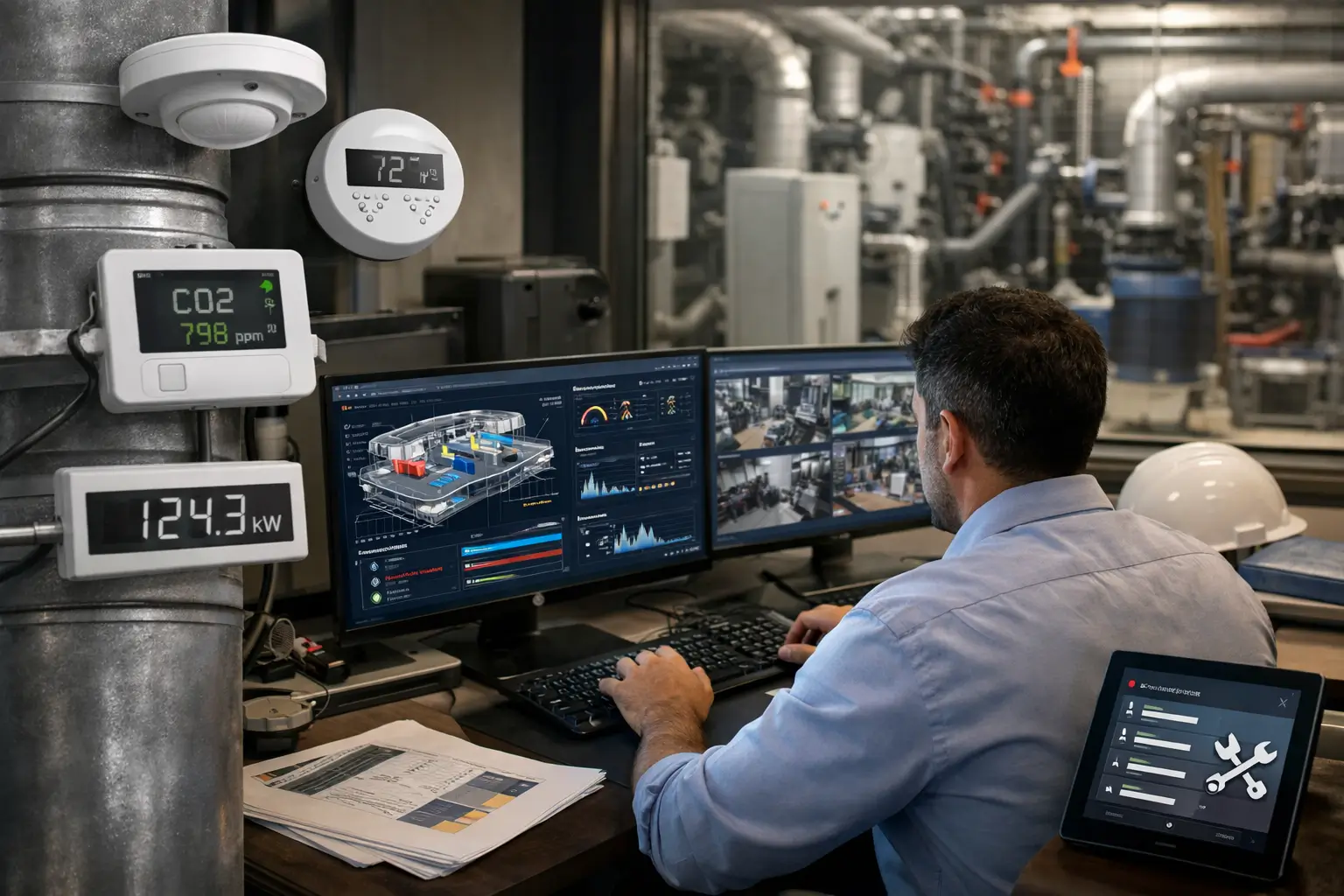
Modern building sensing deployments typically incorporate multiple sensor categories: environmental sensors measuring temperature, humidity, CO2, and particulate matter; energy sensors monitoring electrical consumption at panel, circuit, and device levels; mechanical sensors tracking pressure differentials, flow rates, and vibration signatures; and occupancy sensors using PIR, ultrasonic, or emerging radar-based detection methods.
Communication protocols vary based on application requirements. BACnet (ASHRAE Standard 135) remains the dominant protocol for building automation integration, enabling direct communication with existing BAS infrastructure. Modbus continues to serve legacy equipment and submetering applications. For wireless sensor networks, MQTT has emerged as the preferred lightweight messaging protocol, particularly for cloud connectivity, while LoRaWAN provides long-range, low-power communication for sensors in locations where wired connectivity is impractical or cost-prohibitive.
Sensor placement represents a critical design decision that frequently undermines otherwise well-conceived deployments. A temperature sensor mounted on an exterior wall, near a supply air diffuser, or in direct sunlight provides data that actively misleads control algorithms. Similarly, CO2 sensors positioned too close to return air grilles or too far from occupied zones fail to capture the readings necessary for effective demand-controlled ventilation.
Layer 2: The Connectivity Layer
The connectivity layer determines how sensor data moves from point of collection to point of analysis, and architectural decisions here have profound implications for system performance, reliability, and operating costs.
The edge computing versus cloud computing debate has largely resolved into a hybrid consensus for building applications. Edge devices—computing nodes deployed at the building level—provide several critical capabilities: latency reduction for time-sensitive control applications, continued operation during network outages, preprocessing that reduces bandwidth requirements and cloud computing costs, and enhanced data security by limiting the transmission of raw operational data.
Pure cloud architectures, while simpler to deploy initially, introduce latency that can undermine closed-loop control applications and create single points of failure that leave buildings operationally blind during connectivity disruptions. Most mature deployments now implement edge computing for real-time processing and local control, with cloud platforms handling long-term storage, cross-portfolio analytics, and machine learning model training.
Network architecture must also address cybersecurity from the design phase. Building IoT networks should be segmented from corporate IT infrastructure, with firewalls and access controls preventing lateral movement from compromised sensors to critical building systems or enterprise networks.
Layer 3: The Analytics Layer
The analytics layer is where raw data transforms into operational insight, and the sophistication of this transformation largely determines whether a deployment delivers value or joins the dashboard graveyard.
Analytics capabilities exist along a maturity spectrum. Descriptive analytics answer the question “What happened?” through visualization of historical trends and current conditions—this is where most deployments stop. Diagnostic analytics answer “Why did it happen?” through correlation analysis and rule-based evaluation. Predictive analytics answer “What will happen?” through statistical modeling and machine learning algorithms that identify patterns preceding equipment failures or efficiency degradation.
Fault Detection and Diagnostics (FDD) represents the most impactful analytics capability for building performance applications. FDD systems continuously evaluate equipment operation against physics-based rules and statistical baselines to identify faults, inefficiencies, and degradation. ASHRAE Guideline 36, which defines high-performance sequences of operations for HVAC systems, provides standardized control sequences that form the basis for effective FDD rule development.
The quality of FDD implementation varies dramatically across platforms. Basic systems flag obvious faults such as simultaneous heating and cooling. Advanced systems detect subtle degradation patterns—a chiller losing efficiency at 0.3% per month, a damper actuator developing hysteresis, an economizer that functions correctly at design conditions but fails during shoulder season operation.
Layer 4: The Action Layer
The action layer closes the loop between insight and impact, and its absence explains why so many building IoT deployments fail to deliver sustained value. Analytics without action is observation without intervention—interesting but ultimately inconsequential.
Effective action layer implementations encompass three response pathways. Closed-loop control enables automated system adjustments without human intervention, such as optimizing start times based on thermal mass modeling or modulating ventilation rates based on real-time occupancy data. Automated work order generation pushes detected faults directly into CMMS platforms with fault codes, supporting data, and suggested corrective actions, ensuring that insights translate into maintenance activities. Human-in-the-loop escalation routes complex issues requiring engineering judgment to appropriate personnel with sufficient context for rapid decision-making.
The action layer must also incorporate feedback mechanisms that validate whether interventions achieved intended outcomes, enabling continuous improvement of analytics algorithms and operational procedures.
What Good Looks Like: Three Documented Use Cases
Abstract architectural discussions become concrete when examining deployments that have achieved measurable operational improvements.
Automated Fault Detection on Air Handling Units
A 450,000-square-foot commercial office complex implemented FDD across its 12 air handling units, integrating with existing BACnet-based building automation. Within the first 90 days, the system identified 23 previously undetected faults including failed economizer dampers, degraded variable frequency drives, and supply air temperature sensor drift. Systematic fault remediation, prioritized by energy impact, yielded a 15% reduction in HVAC energy consumption—approximately $127,000 in annual savings against a $180,000 implementation cost. Equally important, the building’s tenant comfort complaints decreased by 40% as zone temperature control improved.
Occupancy-Based Ventilation Optimization
A university research facility deployed radar-based occupancy sensors across 180 laboratory and office spaces, integrating occupancy data with the building automation system for demand-controlled ventilation. The implementation followed ASHRAE Standard 62.1 ventilation rate procedure, maintaining code-compliant outdoor air rates while eliminating over-ventilation of unoccupied spaces. The result was a 30% reduction in outdoor air conditioning load, translating to substantial energy savings in a climate with significant heating and cooling degree days. The project achieved simple payback in 2.1 years while improving indoor air quality in occupied spaces through more responsive ventilation adjustment.
Predictive Maintenance Implementation
A healthcare facility implemented vibration monitoring on 45 critical rotating equipment assets including chillers, pumps, and air handling unit fans. Machine learning algorithms trained on manufacturer specifications and historical failure data identified degradation patterns weeks before functional failure would occur. Over an 18-month evaluation period, the system predicted 12 impending failures that would have resulted in emergency repairs, enabling scheduled maintenance during planned downtime windows. The facility documented a 40% reduction in emergency maintenance events for monitored equipment, with associated reductions in overtime labor costs and avoided operational disruptions.
Why Most Deployments Fail: Five Root Causes
Understanding failure modes is essential for avoiding them. Five root causes account for the majority of building IoT deployments that fail to deliver sustained value.
Wrong sensor placement undermines analytics before they begin. Sensors installed based on installation convenience rather than measurement validity generate data that misleads rather than informs. This failure mode is particularly common when sensor deployment is delegated to low-voltage contractors without building systems expertise.
Absence of data governance allows data quality to degrade over time. Without defined procedures for sensor calibration, naming convention maintenance, and metadata management, databases become increasingly unreliable until analytics outputs lose credibility with operations staff.
Analytics without operational integration creates insight that never reaches the people who can act on it. Dashboards displaying faults that no one monitors and alerts that route to unmonitored inboxes represent wasted analytical capability.
Vendor lock-in constrains future evolution and increases total cost of ownership. Proprietary protocols, closed APIs, and sensor-to-cloud architectures that prevent data portability trap building owners in relationships that may not serve long-term interests.
Insufficient trained staff ensures that even well-designed systems eventually fall into disuse. Building IoT systems require ongoing attention from personnel who understand both the technology and building operations—a combination of skills that remains relatively rare.
Selecting an IoT Platform: Six Critical Criteria
Platform selection should be guided by criteria that address both immediate capabilities and long-term operational requirements.
- Open protocol support: The platform should communicate natively with BACnet, Modbus, and common IoT protocols without requiring proprietary gateways that introduce additional points of failure and vendor dependency.
- Edge computing capability: Evaluate whether the platform supports edge deployment for latency-sensitive applications and continued operation during network outages.
- FDD rules library: Assess the depth and customizability of fault detection rules, particularly alignment with ASHRAE Guideline 36 sequences and the ability to create custom rules for site-specific equipment.
- CMMS integration: Confirm that the platform offers robust integration with common computerized maintenance management systems, enabling automated work order creation with sufficient context for maintenance staff.
- Cybersecurity posture: Evaluate the vendor’s security practices including data encryption, access controls, vulnerability management, and compliance with relevant frameworks such as NIST Cybersecurity Framework.
- Total cost of ownership: Calculate all costs across a five-year horizon including licensing, connectivity, cloud computing, integration, and ongoing support—initial purchase price frequently represents less than 30% of total deployment cost.
Implementation Roadmap: Pilot, Prove, Scale
Successful building IoT deployments follow a phased approach that builds organizational capability alongside technical infrastructure.
Pilot phase focuses on a limited scope—typically two to four air handling units or a single floor—with intensive monitoring and rapid iteration. The objective is learning, not scaling. This phase should validate sensor placement, confirm data quality, test analytics against known conditions, and establish integration pathways to existing systems. Duration: three to six months.
Prove phase expands scope while documenting outcomes with rigorous measurement and verification. This phase should generate the business case for broader deployment, including validated energy savings, maintenance impact, and operational efficiency gains. Equally important, this phase develops internal expertise and operational procedures. Duration: six to twelve months.
Scale phase extends proven approaches across the portfolio, with standardized deployment procedures, training programs, and performance expectations. Scaling should be paced to organizational absorption capacity—technology that outpaces operational readiness simply creates larger dashboard graveyards.
Moving Beyond Dashboards to Operational Impact
Building IoT technology has matured to the point where the question is no longer whether these systems can deliver value, but whether organizations can implement them in ways that translate technological capability into sustained operational improvement. The buildings that achieve exceptional performance do so not because they have more sensors or more sophisticated platforms, but because they have designed and implemented systems with clear pathways from data to action, supported by organizational commitment to continuous improvement.
For building owners and facility directors evaluating their current IoT investments or planning new deployments, the path forward requires honest assessment of existing capabilities, clear-eyed evaluation of organizational readiness, and strategic planning that addresses all four architectural layers. Zytona’s building technology assessment provides this foundation, evaluating current systems against best practices, identifying gaps in the sensing-to-action chain, and developing implementation roadmaps aligned with operational objectives. Contact Zytona to schedule an assessment and begin transforming building data into measurable performance improvement.