
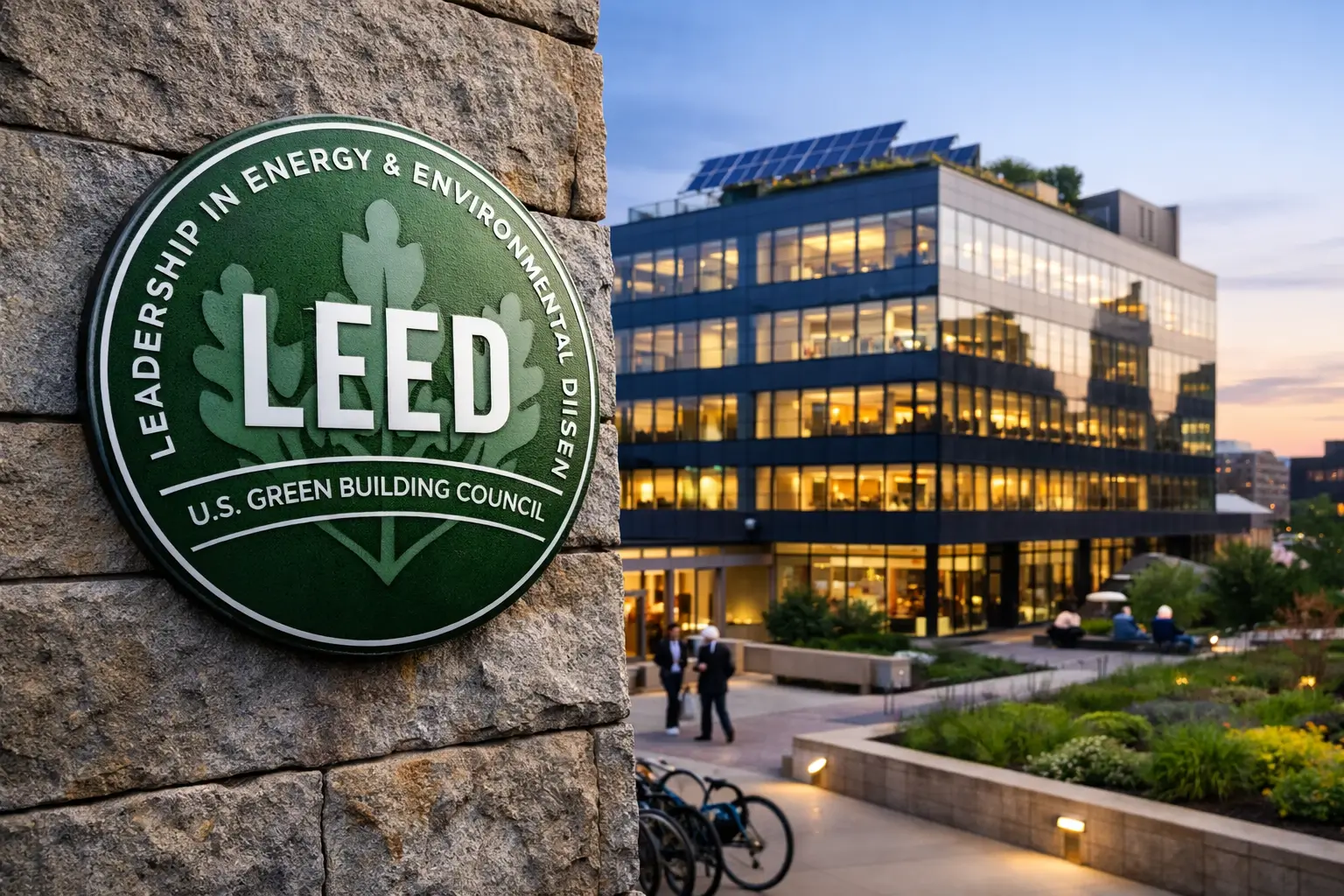
دليل الحصول على شهادة LEED: معلومات جوهرية لأصحاب القرار وملاك المباني
LEED certification has evolved from a niche sustainability credential into a mainstream market differentiator that directly impacts building valuations, tenant attraction, and operating costs. For building owners and developers weighing the investment, the data tells a compelling story: LEED-certified buildings consistently command rent premiums of 3–7% compared to conventional buildings in the same market, according to research from the Institute for Market Transformation and CBRE. Occupancy rates in certified buildings run 4–6% higher on average, and capitalization rates reflect the reduced risk profile that institutional investors associate with high-performance assets.
Beyond the market premiums, LEED certification signals operational efficiency that translates to lower utility costs, reduced maintenance requirements, and improved tenant satisfaction scores. For developers targeting institutional buyers or REITs with ESG mandates, certification has become a de facto requirement rather than a competitive advantage. This guide provides a practical roadmap for understanding the LEED framework, navigating the certification process, and avoiding the common pitfalls that derail projects from achieving their target certification level.
LEED Explained: Understanding the Framework
LEED—Leadership in Energy and Environmental Design—is a green building rating system developed by the U.S. Green Building Council (USGBC) in 1998 and now administered through the Green Business Certification Inc. (GBCI), the certification arm that handles project registration, documentation review, and certification decisions. LEED has certified over 100,000 projects globally, encompassing more than 10 billion square feet of building space across 180 countries.
The current version, LEED v4.1, includes multiple rating systems tailored to different project types and scopes:
LEED BD+C (Building Design and Construction) applies to new construction and major renovations. This rating system evaluates design and construction practices from site selection through substantial completion. It’s the most commonly pursued certification type for new development projects and covers building types including new construction, core and shell, schools, healthcare facilities, retail, hospitality, and data centers.
LEED O+M (Operations and Maintenance) addresses existing buildings seeking certification based on operational performance rather than design intent. O+M certification requires ongoing performance data and recertification every three years, making it particularly relevant for building owners who want to demonstrate sustained operational excellence and continuous improvement.
LEED ID+C (Interior Design and Construction) focuses on tenant improvement projects within existing buildings. This pathway allows tenants to pursue certification for their own spaces independent of the base building’s certification status, though certain credits depend on building-level systems and policies.
Certification Levels: The Four Tiers
LEED certification operates on a 110-point scale, with projects earning points across credit categories based on documented achievement of specific performance criteria. The four certification levels are:
- LEED Certified: 40-49 نقطة
- LEED Silver: 50-59 نقطة
- LEED Gold: 60-79 نقطة
- LEED Platinum: 80+ نقطة
Most commercial projects target Gold certification, which represents a balance between rigorous sustainability performance and practical cost-benefit considerations. Platinum certification requires exceptional performance across nearly all credit categories and typically demands integrated design approaches, advanced building systems, and significant investment in renewable energy or carbon offsets. Silver certification often represents the minimum threshold for projects with sustainability requirements from institutional investors or municipal incentive programs.
The Credit Categories: Building Blocks of Certification
LEED v4.1 organizes credits into eight categories, each addressing a distinct aspect of sustainable building performance:
Location and Transportation (16 points) rewards projects sited near existing infrastructure, public transit, and community resources. Credits address bicycle facilities, reduced parking footprint, and access to diverse uses that reduce vehicle miles traveled.
Sustainable Sites (10 points) focuses on site development practices including stormwater management, heat island reduction, and light pollution reduction. Credits encourage preservation of existing habitat and integration of open space.
Water Efficiency (11 points) addresses indoor and outdoor water use reduction, water metering, and cooling tower water management. Prerequisites establish baseline performance; credits reward performance significantly exceeding code requirements.
Energy and Atmosphere (33 points) represents the largest point category and addresses building energy performance, commissioning, refrigerant management, renewable energy, and grid harmonization. This category drives much of the engineering complexity in LEED projects.
Materials and Resources (13 points) rewards building life-cycle impact reduction, environmentally preferable products, construction waste management, and design for flexibility and adaptability.
Indoor Environmental Quality (16 points) addresses occupant health and comfort through credits for air quality, thermal comfort, lighting quality, acoustic performance, and access to daylight and views.
Innovation (6 points) allows projects to earn points for exceptional performance beyond credit requirements, pilot credits, and having a LEED Accredited Professional on the project team.
Regional Priority (4 points) provides bonus points for addressing environmental priorities specific to the project’s geographic location, as identified by USGBC regional councils.
Where Engineering Verification Matters Most
The Energy and Atmosphere category demands the most rigorous engineering documentation and verification, with prerequisites and credits that require systematic commissioning, energy modeling, and ongoing performance measurement. Understanding these requirements is essential for project planning and budgeting.
EA Prerequisite: Fundamental Commissioning and Verification
This mandatory prerequisite requires commissioning of building energy systems to verify that equipment is installed correctly and operates according to the Owner’s Project Requirements (OPR) and Basis of Design (BOD). The commissioning scope must include HVAC systems, domestic hot water systems, and associated controls. The commissioning authority must review design documents, verify equipment installation, and document functional performance testing results.
EAc Enhanced Commissioning (2–6 points)
Enhanced commissioning extends beyond the prerequisite requirements to include commissioning process activities during the design phase, a comprehensive commissioning plan, envelope commissioning, and ongoing commissioning activities extending ten months post-occupancy. The credit provides pathways for enhanced systems commissioning (2–3 points) and monitoring-based commissioning (2–3 points), with projects able to pursue both pathways.
EAc Optimize Energy Performance (1–18 points)
This credit offers the highest point opportunity in the entire rating system, rewarding demonstrated energy performance improvement compared to the baseline building defined by ASHRAE 90.1-2016 (for LEED v4.1). Points scale based on percentage improvement, from 5% improvement for one point up to 50% or greater for the maximum 18 points. Most projects use the whole-building energy simulation pathway, which requires detailed energy modeling following Appendix G methodology.
EAc Advanced Energy Metering (1 point)
This credit requires installing advanced energy meters for all whole-building energy sources and for any individual energy end uses representing 10% or more of total annual consumption. Meters must be capable of storing data for at least 36 months and must report data remotely, enabling ongoing performance monitoring and optimization.
EAc Building-Level Energy Metering (required)
As a prerequisite in LEED v4.1, building-level metering commits project teams to sharing energy performance data with USGBC for five years through the Arc performance platform. This requirement supports USGBC’s research initiatives and establishes accountability for actual operational performance versus design predictions.
The Certification Process: Five Key Steps
LEED certification follows a structured process from project registration through final certification:
- Project Registration: Register the project through LEED Online, establishing the project in GBCI’s system, selecting the appropriate rating system, and gaining access to documentation templates. Registration fees vary by project size and membership status.
- Documentation Preparation: Compile credit-specific documentation including calculations, drawings, specifications, policies, and verification reports. Each credit has defined documentation requirements and upload formats.
- Design and Construction Reviews: Submit documentation for GBCI review. Most projects split submissions into design review (after construction documents) and construction review (after substantial completion). GBCI assigns reviewers who evaluate documentation against credit requirements.
- Certification Decision: GBCI issues preliminary review results, identifying credits awarded, denied, or requiring clarification. Project teams can accept results or appeal specific credit decisions. Final certification is issued once all reviews are complete and the project accepts results.
- Plaque and Recognition: Certified projects receive a LEED plaque for building display, inclusion in GBCI’s certified project database, and permission to use the LEED certification mark in marketing materials.
Common Mistakes That Derail Certification Goals
Five recurring pitfalls cause projects to fall short of their target certification level:
Starting LEED tracking too late: Many credits require documentation of decisions and activities that occur early in design. Engaging LEED consultants after design development often means lost credit opportunities and expensive redesign.
Overreliance on energy modeling points: Projects that count on achieving maximum energy performance points frequently fall short when actual modeling results come in lower than anticipated. Building a 10–15 point cushion into credit planning protects against this risk.
Inadequate commissioning scope: Commissioning providers unfamiliar with LEED requirements may deliver reports that fail to document activities in the format and detail that credit requirements demand, resulting in denied credits even when underlying work was performed.
Insufficient product documentation: Materials credits require manufacturer documentation meeting specific disclosure standards. Last-minute product substitutions or inadequate submittals from suppliers create documentation gaps that reviewers flag.
Ignoring Regional Priority credits: These credits provide bonus points for achieving regionally important credits—essentially free points for projects already achieving those credits. Failing to claim eligible Regional Priority credits leaves points on the table.
Cost Versus Value: Making the Business Case
Certification costs include GBCI registration and certification fees, LEED consulting services, additional design and engineering fees for documentation, and any construction cost premiums for required performance levels. Typical costs by project size:
- Small projects (under 50,000 SF): $30,000–$75,000 total soft costs
- Mid-size projects (50,000–250,000 SF): $75,000–$200,000 total soft costs
- Large projects (over 250,000 SF): $200,000–$500,000 total soft costs
Construction cost premiums for achieving Gold certification typically range from 0–3% depending on baseline design quality, geographic location, and project type. Many projects achieve certification with minimal cost premium by integrating sustainability requirements early in design.
The financial return encompasses multiple value streams: rental premiums, occupancy improvements, reduced operating costs, utility and tax incentives available in many jurisdictions, and improved asset valuations that translate to lower capitalization rates and higher sale prices. For a typical 150,000 SF office building, even a modest 4% rent premium translates to $180,000–$300,000 in additional annual revenue against certification costs that represent a fraction of one year’s premium.
The path to successful LEED certification requires early planning, integrated design, and verification expertise that ensures credits are documented correctly the first time. Whether your project is pursuing certification for competitive positioning, tenant requirements, or operational benefits, the process rewards methodical preparation and technical rigor. For owners ready to develop a certification strategy tailored to their project’s goals and market position, Zytona offers a downloadable LEED Certification Roadmap PDF that outlines the critical milestones, documentation requirements, and engineering verification activities needed to achieve your target certification level—available now through our building performance resources portal.