
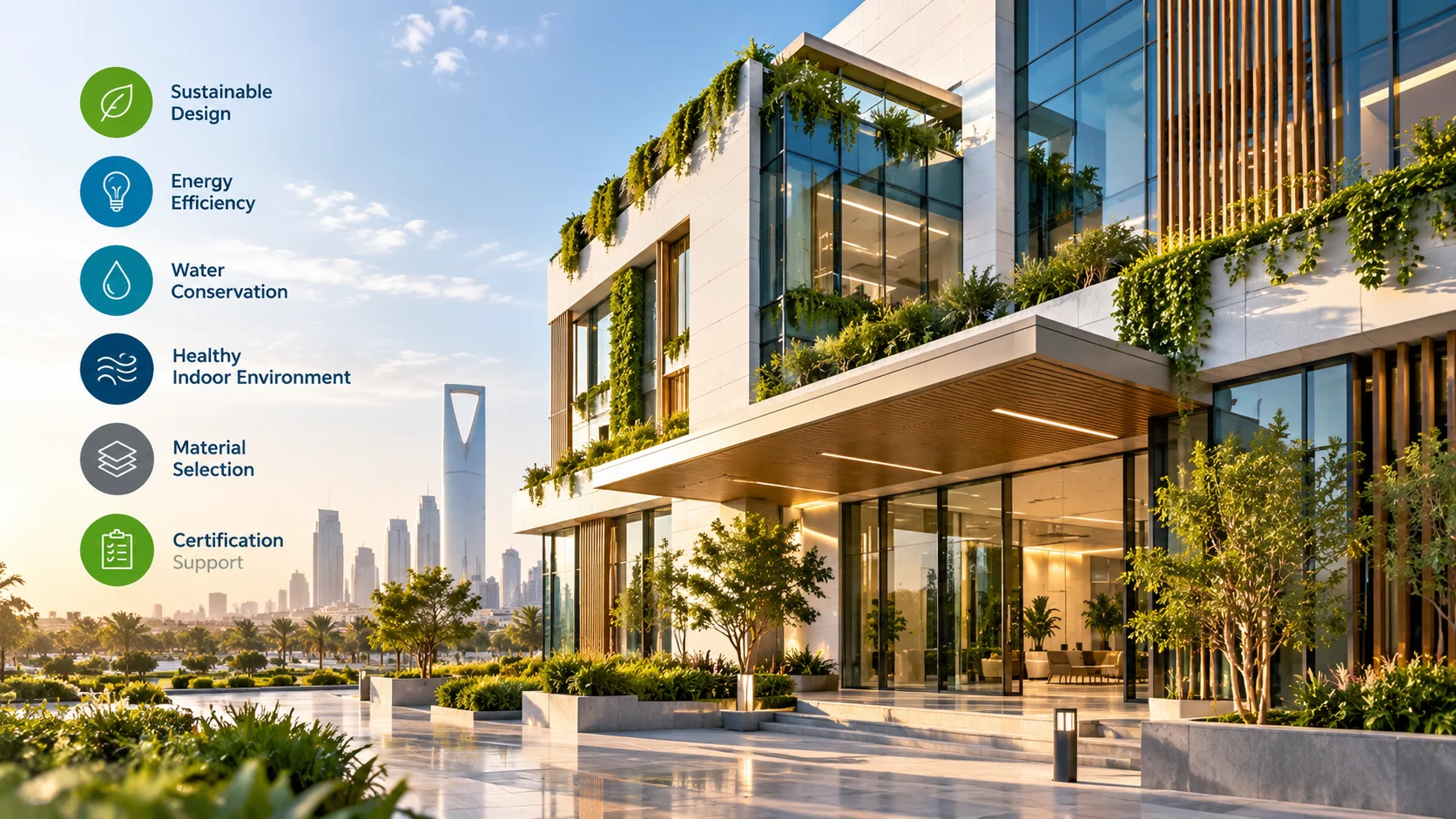
Pursuing LEED or another green building certification can feel straightforward on paper. A project must meet credit requirements, submit documentation, and receive its certification plaque.
In practice, certification involves nearly every project discipline. These include architecture, mechanical engineering, procurement, and facilities operations.
A single missed requirement or late-discovered gap can result in lost credits, redesign costs, or a lower certification tier than the project could otherwise achieve.
This guide covers three closely related services that help owners manage this complexity successfully: LEED consulting services, LEED certification support, and green building certification more broadly.
Why Expert Guidance Matters for LEED Certification
Green building certification programs use a points-based credit system.
A project may meet the correct technical specifications on paper but still fail to achieve its certification target. This can happen when the project team does not track and coordinate credits from the beginning.
Certification requirements also directly affect design decisions, procurement timelines, construction sequencing, and building operations after occupancy.
Different people make these decisions, often without full visibility into their effects on the overall certification strategy.
Experienced consulting support helps coordinate all these activities toward a single, achievable certification goal.
Ideally, the project team identifies and confirms this goal as early as possible in the project’s lifecycle.
LEED Consulting Services
LEED consulting services provide the strategic guidance a project team needs to pursue LEED certification successfully.
This guidance begins with initial goal-setting and continues through final submission and beyond.
A LEED consultant serves as both a technical expert on the rating system and a project coordinator.
The consultant translates certification requirements into practical guidance for architects, engineers, contractors, and owners.
Where Consulting Begins
The earliest and most valuable time for a LEED consultant to join a project is during pre-design or early schematic design.
At this stage, the consultant can still influence major decisions without creating redesign costs.
These decisions include site selection, building orientation, systems selection, and the overall project budget.
The consultant typically helps the owner select a target certification level: Certified, Silver, Gold, or Platinum.
This selection depends on project goals, budget, and local incentive programs.
The consultant also develops a credit strategy that identifies which available credits the project can realistically pursue.
Credit Tracking and Coordination
LEED credits cover several categories. These include location and transportation, sustainable sites, water efficiency, energy and atmosphere, materials and resources, and indoor environmental quality.
A consultant coordinates input from multiple disciplines and tracks progress toward each targeted credit throughout design and construction.
This work includes reviewing drawings and specifications for compliance.
The consultant also identifies design decisions that could jeopardize targeted credits.
In addition, the consultant looks for opportunities to obtain additional credits. These may be credits that the original strategy did not include but that became achievable as the design developed.
Avoiding the Most Common Pitfalls
Projects frequently lose achievable credits even when the underlying building qualifies.
This can happen because teams fail to collect documentation at the appropriate time.
It can also occur when a subcontractor does not receive information about material requirements before purchasing.
Another common issue arises when the project team fails to coordinate a credit prerequisite with the responsible trade.
An experienced consultant anticipates these problems by recognizing patterns from previous projects.
The consultant identifies gaps early enough for the team to correct them, rather than discovering missed requirements during final review.
At that stage, correcting a problem may already be too late.
LEED Certification Support
LEED consulting covers the full strategic development of a project.
However, certification support often focuses more specifically on the documentation, submission, and administrative processes required to achieve formal LEED certification.
These processes involve the U.S. Green Building Council and Green Business Certification Inc. (GBCI), which administers LEED reviews.
Documentation Management
Every LEED credit requires specific supporting documentation.
Depending on the credit, this may include calculations, product data sheets, narratives, photographs, or third-party verification.
Certification support services organize and compile this documentation throughout the project.
This approach avoids the need to assemble everything retroactively at the end.
Collecting documentation after project completion takes considerably more time and increases the likelihood of missing information.
Documenting requirements as teams complete the work helps reduce these difficulties.
Managing the Review Process
For larger or more complex projects, LEED certification typically involves two submission phases.
The first phase is the design review, which takes place after the team completes the construction documents.
The second phase is the construction review, which follows building completion and occupancy.
GBCI reviewers may classify credits as “anticipated” or “denied.” They may also request clarification.
Certification support includes preparing formal responses to reviewer comments.
When necessary, the process also includes appeals to address credits that did not receive approval during the initial submission.
Coordinating LEED Online
Project teams manage LEED documentation and communication with reviewers through the USGBC’s LEED Online platform.
The platform has its own structure, requirements, and submission templates for each credit.
Certification support services manage this platform on behalf of the owner.
They help ensure that submissions are complete, properly formatted, and submitted within program deadlines.
Post-Certification Requirements
For projects certifying under LEED for existing buildings (LEED O+M), certification is not a one-time achievement.
Maintaining certification requires ongoing performance data and periodic recertification.
In this situation, certification support becomes an ongoing relationship.
Support teams help facility personnel maintain the operational practices and data tracking necessary to keep certification current.
Green Building Certification Beyond LEED
LEED is the most widely recognized green building certification in North America.
However, it is not the only available program.
For some projects, an alternative or complementary certification may better match the owner’s goals.
Other Major Certification Programs
The WELL Building Standard focuses specifically on occupant health and wellness.
It addresses air and water quality, lighting, and mental health considerations.
Project teams increasingly pursue WELL alongside LEED rather than treating it as a substitute.
ENERGY STAR certification recognizes buildings that demonstrate top-tier energy performance compared with similar buildings nationally.
It often serves as a lower-cost complement to LEED, particularly for existing buildings.
Other certification programs include BREEAM, which is more common internationally, Green Globes, Fitwel, and Passive House.
Each program emphasizes somewhat different priorities.
These may include a streamlined certification process, a health-first framework, or extremely low energy consumption targets.
Choosing the Right Certification for a Project
The appropriate certification path depends on the owner’s priorities, budget, and intended audience.
A developer targeting institutional investors or corporate tenants with strong sustainability commitments may find LEED’s broad market recognition most valuable.
An owner focused specifically on occupant health outcomes may prioritize WELL.
For example, a corporate headquarters competing for talent may place greater importance on occupant health.
A portfolio owner focused primarily on reducing operating costs across many existing buildings may prefer ENERGY STAR.
Its lower cost and simpler process may deliver most of the value with a fraction of the effort.
Many projects now pursue more than one certification simultaneously.
This approach is possible because programs often share much of the same underlying data collection and building improvements.
The Business Case for Certification
Across virtually all green building certification programs, owners consistently report similar benefits.
These include higher achievable lease rates, stronger tenant retention, and improved marketability during sale or refinancing.
In many jurisdictions, certification can also provide access to tax incentives, expedited permitting, or density bonuses.
These benefits can directly affect a project’s financial returns.
Certification also plays an increasing role in ESG reporting and green financing terms.
As a result, certification is both a financial and an environmental decision.
Bringing It All Together
LEED consulting services and LEED certification support work alongside the broader range of green building certification programs.
Together, these services help turn a sustainability goal into a documented and achievable outcome.
Consulting establishes the strategy early enough to influence design decisions before changes become expensive.
Certification support manages the detailed documentation and submission process that ultimately earns the credential.
Understanding the wider certification landscape also helps owners select or combine programs that match their goals.
These goals may involve energy performance, occupant health, market positioning, or all three.
Projects achieve stronger results with fewer surprises when they engage support early.
They also benefit from treating certification as an integrated part of design and construction rather than an afterthought.
الأسئلة المتكررة
How Early Should a LEED Consultant Be Brought Onto a Project?
As early as possible, ideally during pre-design or early schematic design.
Major decisions affecting achievable credits include site selection, systems design, and the overall budget.
Project teams can influence these decisions much more easily and at lower cost before finalizing them.
Revisiting those decisions later is more difficult and expensive.
What’s the Difference Between LEED Consulting and LEED Certification Support?
LEED consulting typically covers the full strategic process.
This includes credit strategy, design coordination, and ongoing project guidance.
LEED certification support focuses more specifically on documentation compilation and formal submission through LEED Online and GBCI review.
However, many providers deliver both services together.
Can a Building Pursue LEED and WELL Certification at the Same Time?
Yes. Pursuing both certifications simultaneously is becoming increasingly common.
The two programs address different but complementary priorities.
LEED focuses on energy and environmental performance, while WELL focuses on occupant health.
Much of the underlying data collection and building improvements can support both certifications at the same time.
What Happens if a Project Doesn’t Achieve Its Targeted LEED Certification Level?
Projects can appeal denied credits during the review process.
If the project still does not achieve its targeted level after appeals, it typically receives certification at the level supported by its final approved point total.
LEED awards certification according to the total points earned rather than requiring the project to achieve a specific pre-selected tier.
Does LEED Certification Require Ongoing Costs After the Building Is Complete?
For new construction and major renovation certifications, maintaining the certification itself does not require ongoing costs.
However, buildings certifying or recertifying under LEED O+M must submit performance data periodically.
They must also complete periodic reviews to maintain certification over time.