
Testing & Balancing: The Most Overlooked Performance Opportunity
The complaints follow a familiar pattern. The fourth floor runs hot while the second floor stays cold. Energy bills creep upward despite no obvious changes in occupancy or operations. Air handling units run longer than they should, struggling to maintain setpoints that were easily achieved when the building was new. Maintenance teams chase individual symptoms—adjusting thermostats, replacing sensors, tweaking schedules—without resolving the underlying condition.
These aren’t equipment failures. They’re testing and balancing problems hiding in plain sight.
Testing and balancing represents one of the most cost-effective opportunities to improve building performance, yet it remains chronically underutilized. Many buildings operate for years—sometimes decades—on systems that have never been properly balanced or that drifted significantly from their original commissioning. The result is energy waste, premature equipment wear, poor indoor air quality, and a steady stream of occupant complaints that consume facility management resources.
What Is Testing and Balancing?
Testing and balancing (T&B) is the systematic process of measuring and adjusting HVAC systems to deliver the airflows and water flows specified in the mechanical design. It ensures that every terminal device, every duct run, and every pipe circuit delivers exactly what the engineer intended.
Air-Side Testing and Balancing
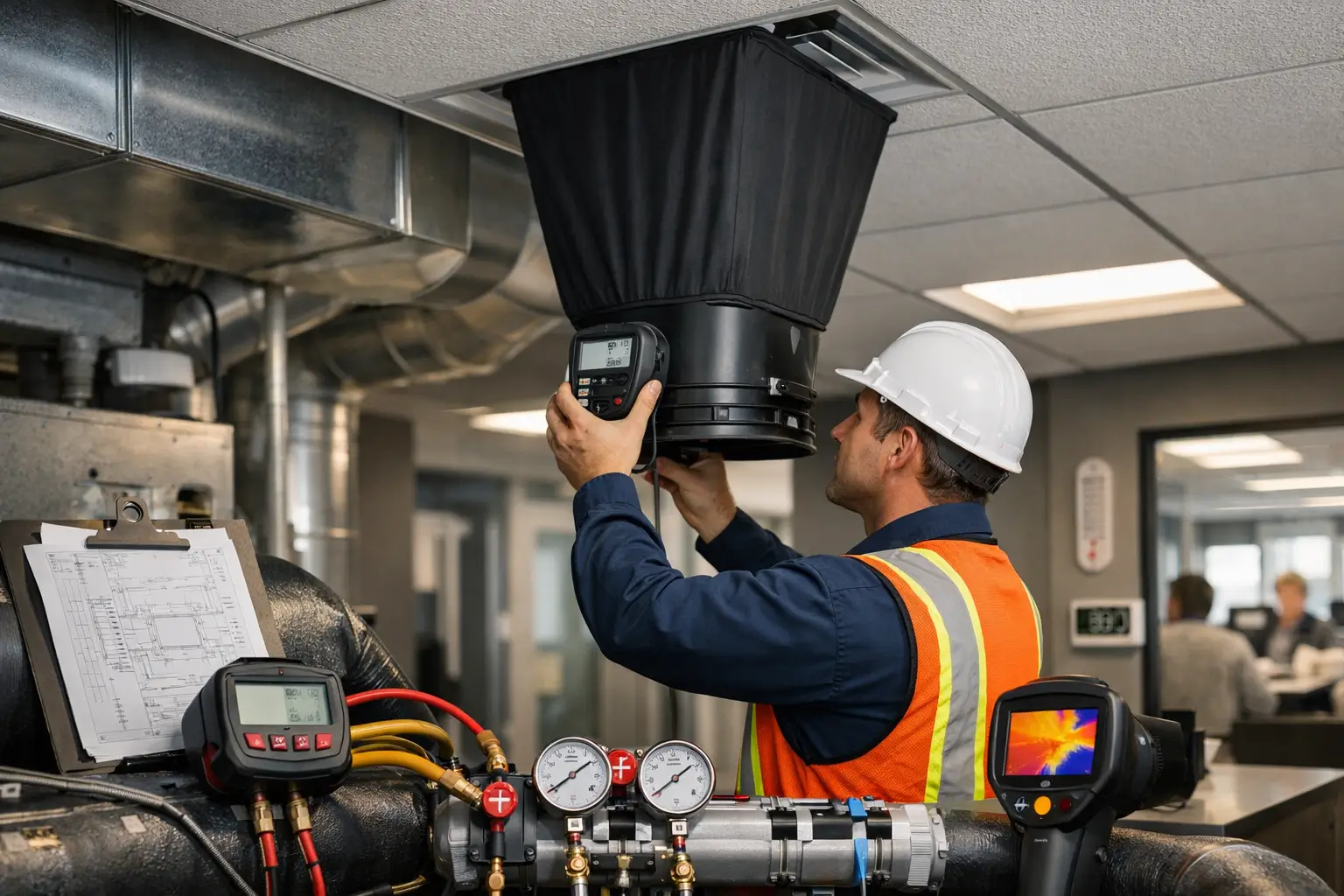
Air-side T&B focuses on verifying cubic feet per minute (CFM) at every supply diffuser, return grille, and exhaust point. Technicians use calibrated instruments—typically rotating vane anemometers, thermal anemometers, or flow hoods—to measure actual airflow and compare it against design specifications. Adjustments are made through balancing dampers, fan speed modifications, and sheave changes until measured values match design within acceptable tolerances.
Hydronic Testing and Balancing
Hydronic T&B applies the same principles to water-based systems. Technicians verify gallons per minute (GPM) through chillers, boilers, cooling towers, and terminal units like fan coils, VAV reheat coils, and radiant panels. Measurements are taken using ultrasonic flow meters, differential pressure across calibrated balancing valves, or direct reading devices. Circuit balancing valves are adjusted to ensure each terminal receives its design flow rate.
Professional T&B work follows rigorous procedures established by certification bodies including the National Environmental Balancing Bureau (NEBB) and the Associated Air Balance Council (AABC). These organizations maintain standards for instrumentation accuracy, measurement techniques, documentation requirements, and technician certification that distinguish professional balancing from informal adjustments.
What Happens When Systems Aren’t Balanced
Unbalanced systems create cascading problems that extend well beyond thermal comfort. The consequences fall into four primary categories:
Energy Waste
Systems compensate for imbalances through brute force. When some zones receive insufficient airflow, fans run harder and longer to maintain space temperatures. Chillers and boilers operate at elevated capacities to overcome distribution inefficiencies. Research from the American Society of Heating, Refrigerating and Air-Conditioning Engineers (ASHRAE) and various energy studies indicates that improper balancing typically increases HVAC energy consumption by 15 to 30 percent. In a commercial building where HVAC represents 40 percent or more of total energy use, this translates directly to unnecessary operating costs.
Accelerated Equipment Wear
Extended runtime and elevated operating pressures stress mechanical components. Fan bearings, motor windings, pump seals, and compressors experience wear rates that exceed design assumptions. Equipment that should deliver 20 years of service fails in 12 or 15, and maintenance intervals tighten as components degrade. The capital cost implications compound over building lifecycles.
Indoor Air Quality Degradation
Pressure imbalances between zones create uncontrolled air migration. Negatively pressurized spaces draw air from adjacent areas, mechanical rooms, or building cavities—bringing pollutants, moisture, and odors that the ventilation system was designed to exclude. Positively pressurized spaces push conditioned air into wall assemblies and ceiling plenums, wasting energy and potentially creating moisture problems. Minimum outdoor air requirements become unreliable when return and exhaust flows don’t match design intent.
Occupant Complaints Driving Operating Costs
Comfort complaints consume facility management resources disproportionately. Each hot or cold call requires investigation, documentation, and response. Maintenance staff spend hours chasing symptoms that could be resolved through systematic balancing. In tenant-occupied buildings, persistent comfort issues affect lease renewals and rental rates. Studies by organizations including BOMA International confirm that HVAC comfort ranks among the top factors influencing tenant satisfaction and retention.
When T&B Is Required Versus Recommended
Code and Standard Requirements
ASHRAE Standard 90.1, adopted by reference in most building energy codes, requires air system balancing for new construction and major renovations. Section 6.7.2.3 specifically mandates that HVAC systems be balanced in accordance with industry-accepted procedures. LEED certification under the Building Design and Construction rating system requires verification of outside air delivery rates and system balancing as part of Enhanced Commissioning credits and Indoor Environmental Quality prerequisites.
Recommended Triggers for Existing Buildings
Beyond code requirements, testing and balancing should be considered whenever operating conditions change significantly:
- Renovation or tenant improvement projects that modify ductwork, add or remove terminal units, or change space layouts
- Occupancy changes that shift cooling loads, ventilation requirements, or operating schedules
- Persistent comfort complaints concentrated in specific zones or following seasonal patterns
- Unexplained energy consumption increases not attributable to weather, rates, or occupancy
- Equipment replacements including air handling units, fans, or pumps with different performance characteristics than original equipment
The T&B Process
Professional testing and balancing follows a structured sequence that ensures accurate results and complete documentation:
Step 1: System Documentation Review
Technicians review mechanical drawings, equipment schedules, and original design specifications to establish target values. This includes design CFM and GPM for every terminal device, fan and pump design points, and system pressure requirements. Where original documents are unavailable, engineers may need to reconstruct design intent based on equipment nameplates and space requirements.
Step 2: Traverse Measurements
Initial measurements establish baseline conditions. Duct traverses using pitot tubes or thermal anemometers determine total system airflow at air handling units and major branch ducts. Hydronic systems are measured at mains and risers to verify pump performance and overall system flow.
Step 3: Damper and Valve Adjustments
Working systematically from the equipment toward terminal devices, technicians adjust balancing dampers and valves to redistribute flow. This process typically requires multiple passes through the system, as adjustments at one point affect conditions elsewhere. Experienced technicians minimize iterations through understanding of system hydraulics and aerodynamics.
Step 4: Verification Readings
After adjustments are complete, technicians return to each measurement point to verify that final conditions meet design specifications. Industry standards typically require airflows within plus or minus 10 percent of design values, though critical applications may demand tighter tolerances.
Step 5: Final Report
Certified T&B reports document every measurement point, comparing as-found conditions, design values, and final balanced conditions. These reports become permanent building records essential for future troubleshooting, renovation planning, and system modifications.
How Often Should T&B Be Done?
Testing and balancing frequency depends on building type, occupancy stability, and system complexity:
- Healthcare facilities: Annual verification of critical areas including operating rooms, isolation rooms, and pharmacies; full rebalancing every three to five years
- Laboratories and cleanrooms: Annual verification with rebalancing after any modification to fume hoods, biosafety cabinets, or air handling equipment
- Commercial office buildings: Full rebalancing every five to seven years, with spot verification following tenant improvements
- Educational facilities: Rebalancing every five to seven years, typically scheduled during summer breaks
- Retail and hospitality: Rebalancing every seven to ten years unless significant renovations occur
Buildings experiencing frequent comfort complaints, unexplained energy increases, or significant occupancy changes should consider verification testing regardless of elapsed time since previous balancing.
Testing and balancing delivers measurable returns through reduced energy consumption, extended equipment life, improved occupant comfort, and lower maintenance burden. For facility managers seeking to optimize building performance without major capital investment, T&B represents a logical starting point. Zytona’s certified technicians provide comprehensive air-side and hydronic testing and balancing services that document current conditions, identify deficiencies, and deliver systems operating at design specifications. Contact Zytona to schedule a T&B assessment and discover the performance potential your building has been missing.